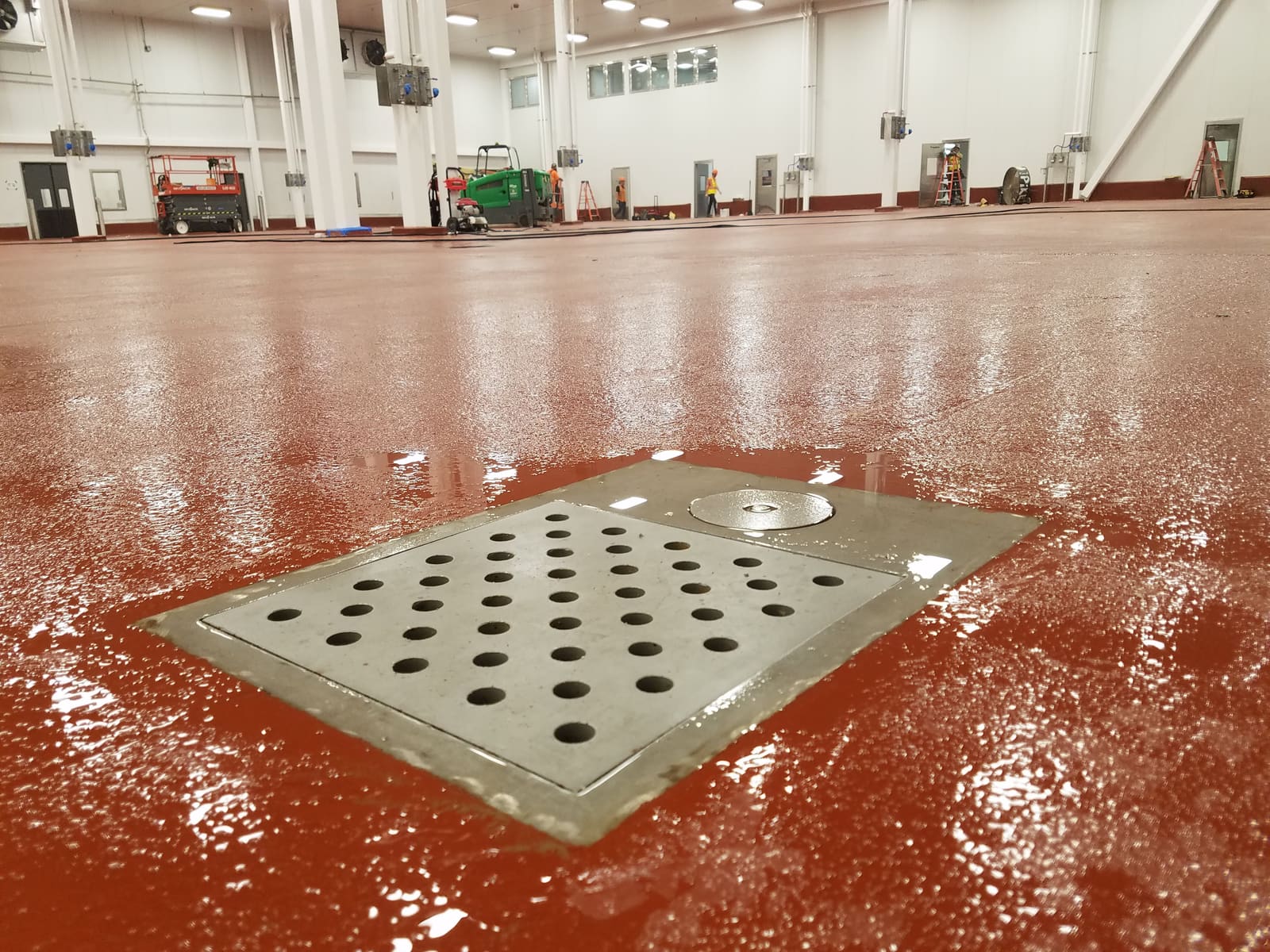
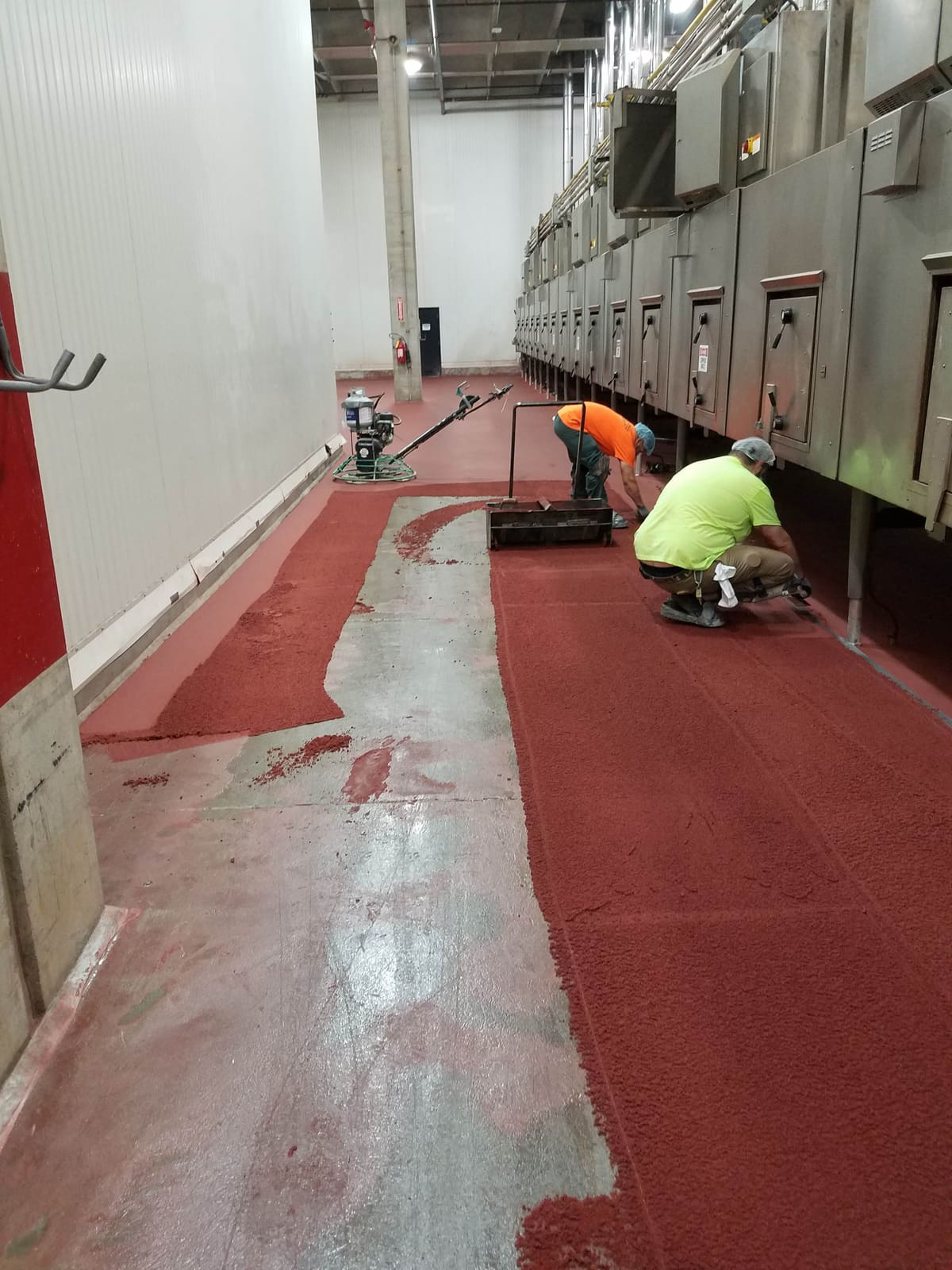
Self-leveling urethane cement with a quartz broadcast — a brand-new 3/16-inch floor over your existing slab, built for kitchens, breweries, and the hardest rooms in the building.
A self-leveling urethane cement system that builds a brand-new, 3/16-inch wear surface on top of tired or hard-used concrete — the toughest floor we install.
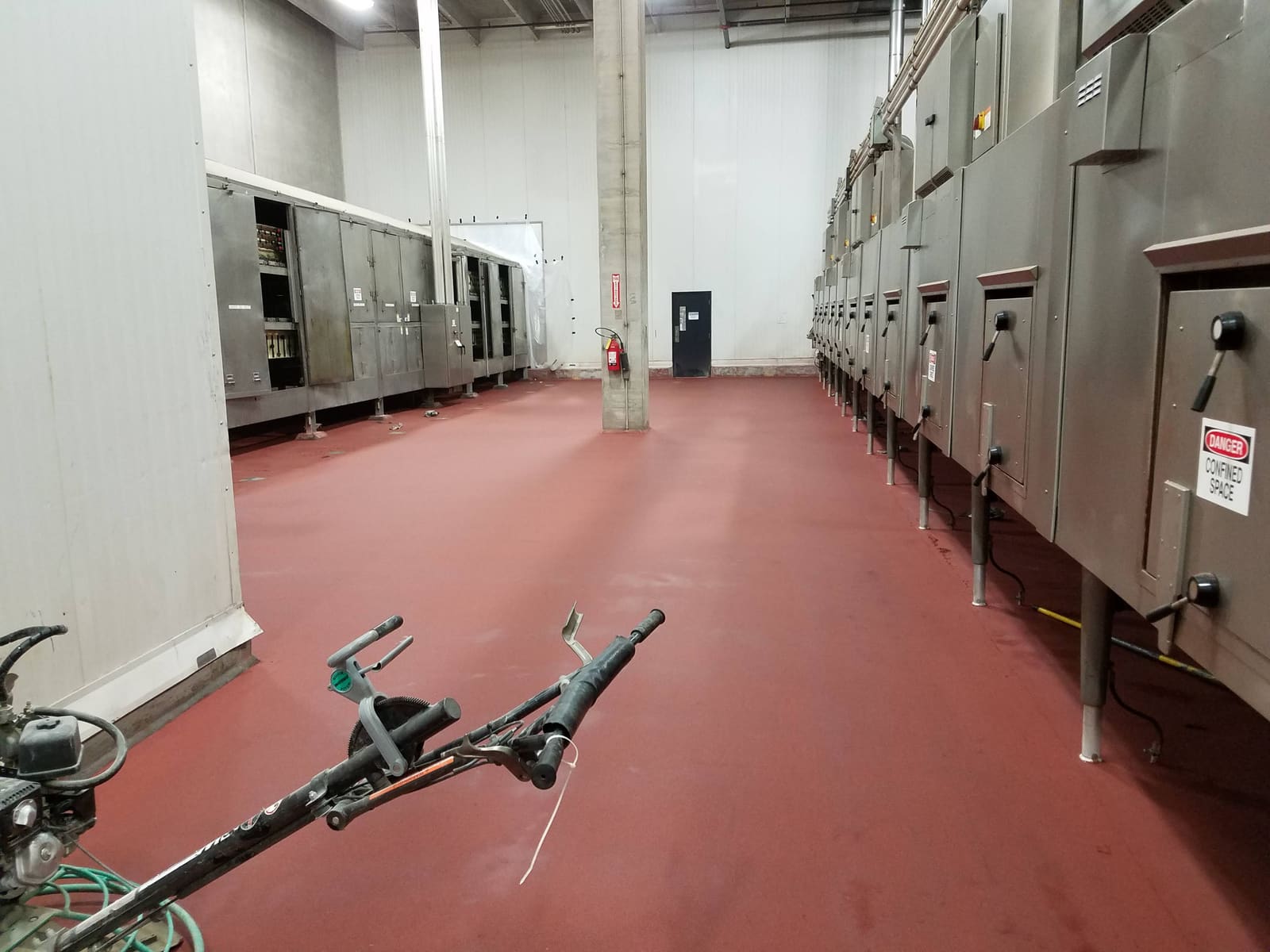
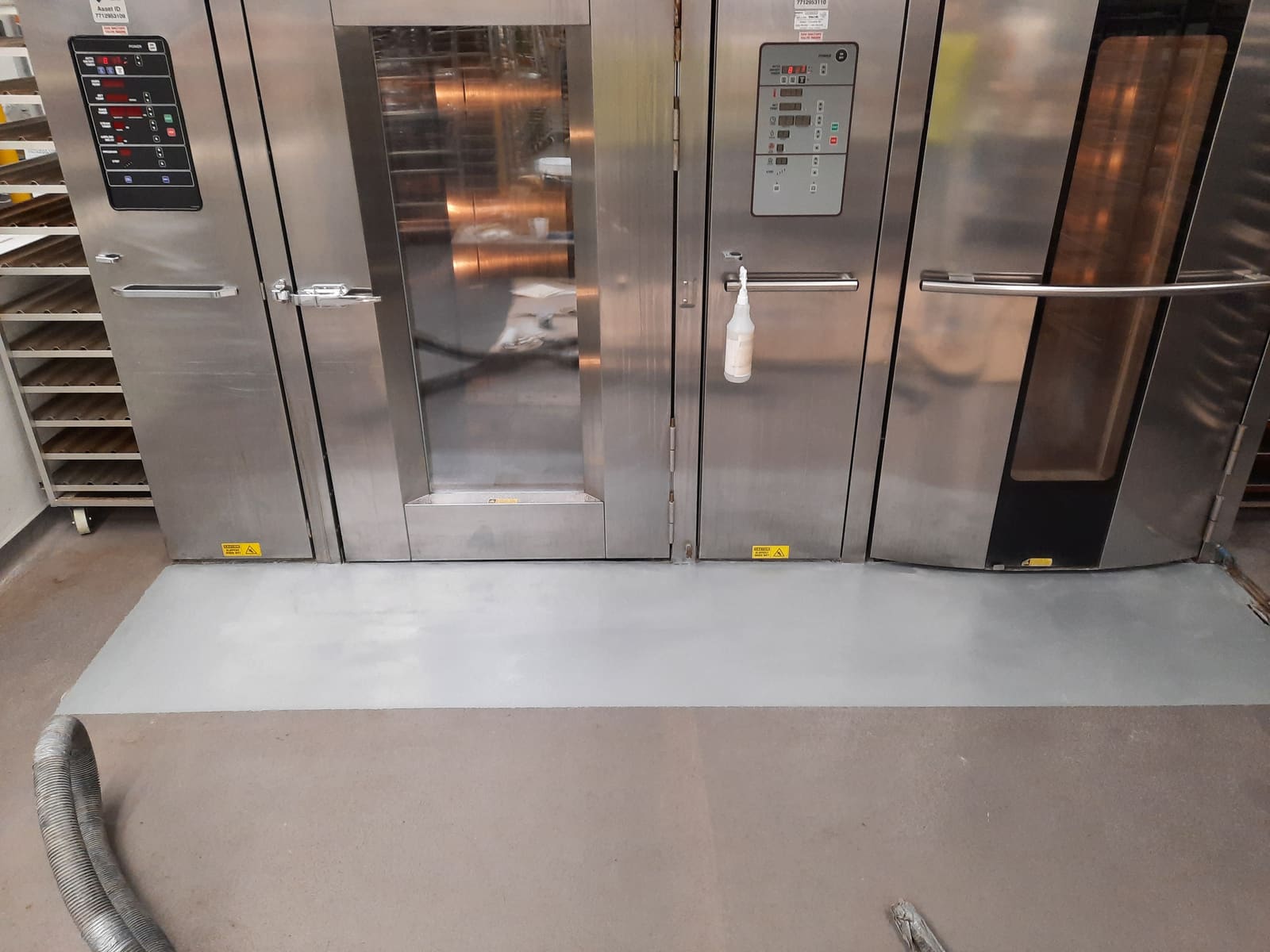
Some floors are past the point where a coating alone is honest medicine — spalled from years of thermal shock, rutted at the wash-down lane, or scarred from decades of duty. And some environments are simply too brutal for conventional coatings: commercial kitchens hitting a 40°F walk-in floor with 180°F wash water, breweries dumping hot caustic, processing rooms that get steam-cleaned nightly. That's overlay territory.
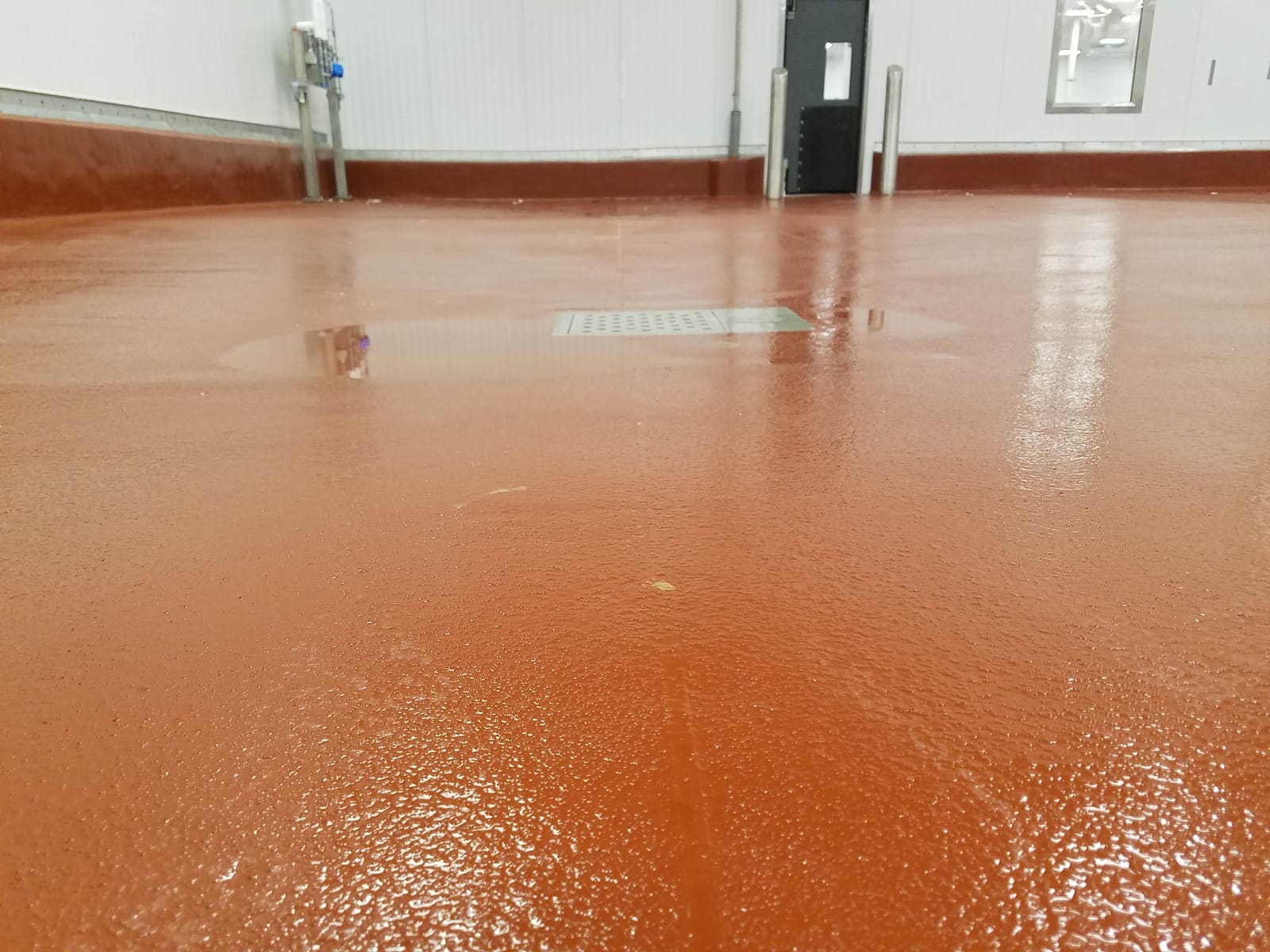
Our system is a self-leveling urethane cement — a hybrid of urethane resin and cementitious filler that pours out at a nominal 1/8 inch and cures into a surface with concrete-like thermal behavior and resin-like chemical resistance. While it's wet, we broadcast colored quartz to rejection, building the finished floor to roughly 3/16 inch with a dense, slip-resistant texture made for wet work. A polyaspartic topcoat locks in the quartz and dials the final grip.
Two properties make urethane cement special. First, thermal shock resistance: it expands and contracts at nearly the same rate as concrete, so hot-water wash-downs and steam cleaning don't pop it loose the way they eventually pop rigid coatings. Second, moisture tolerance: it handles vapor transmission up to 12 pounds per 1,000 square feet per day, so it goes down confidently on damp, on-grade slabs that would disqualify many systems.
Beyond heavy-duty urethane cement, we install cementitious self-leveling overlays to flatten wavy, worn, or patched slabs — creating a fresh, uniform canvas that can then be coated, polished, or stained. If your slab is too rough for the finish you want, an overlay is how we get you there.
Urethane Cement Overlay — Layer by Layer
If the floor gets hot water, harsh chemistry, or relentless wet traffic — urethane cement is the industry answer.
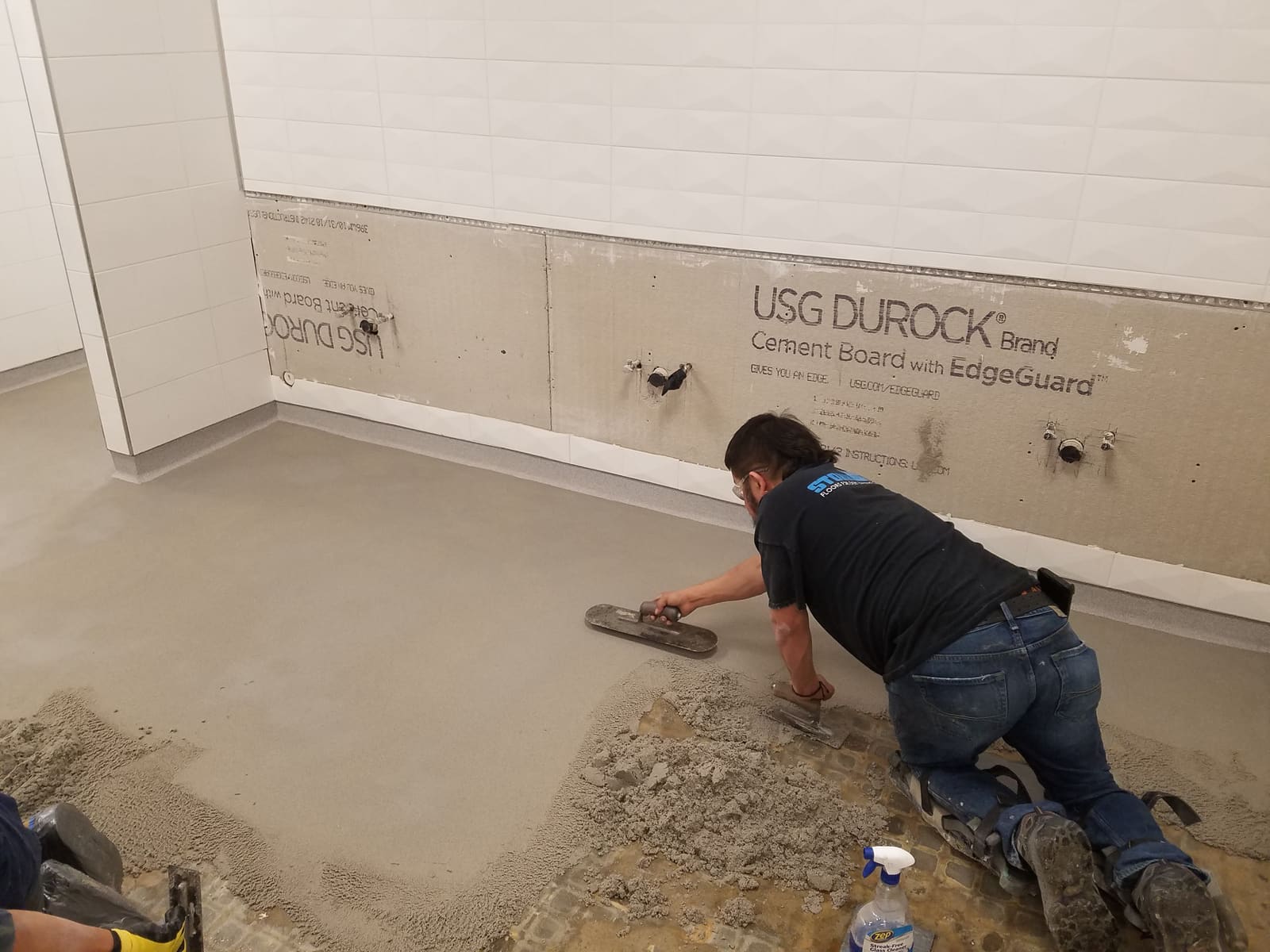
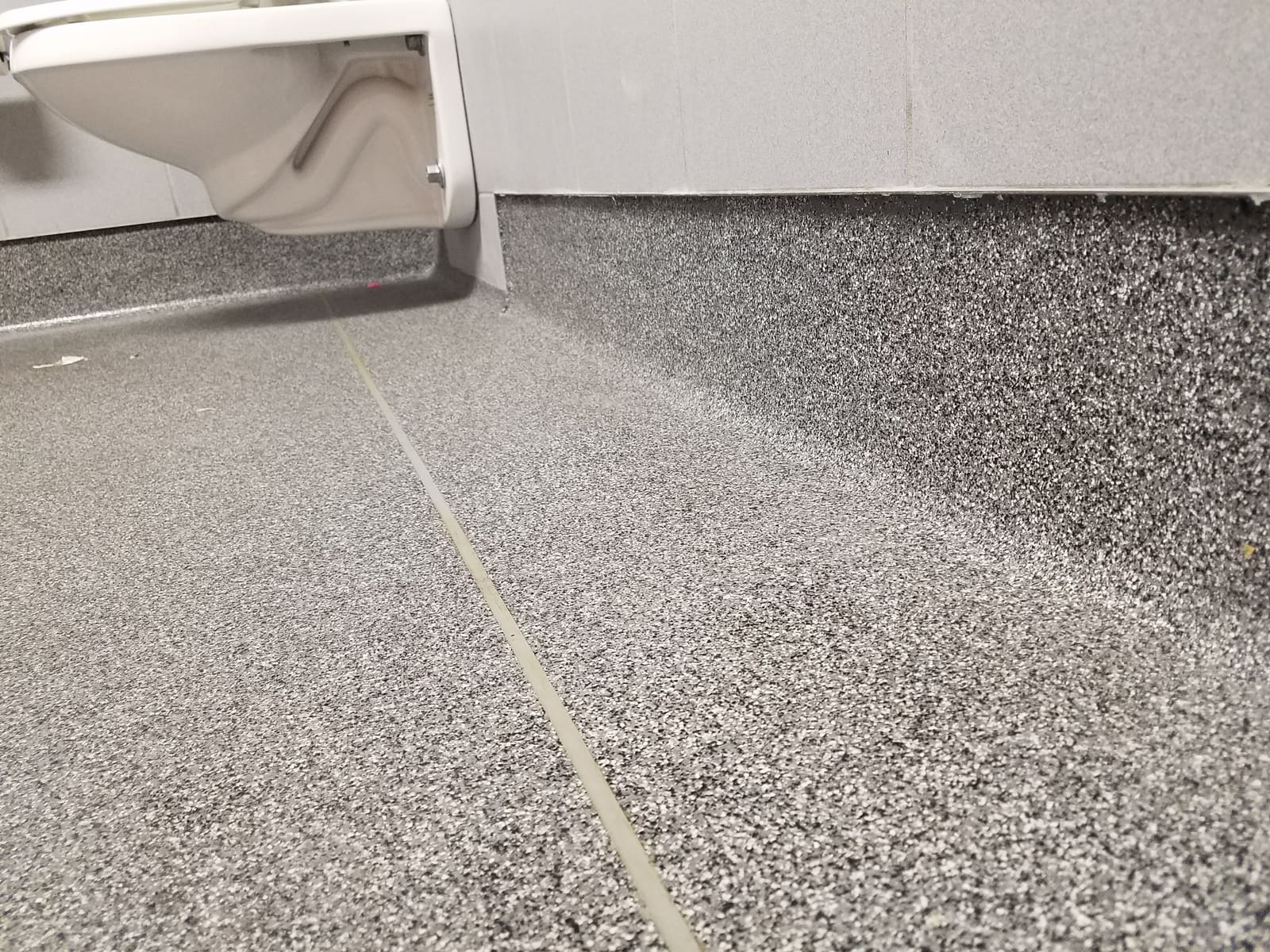
In wash-down environments, the seam where floor meets wall is where trouble lives — water wicks in, grime collects, and health inspectors go looking. An integral cove base eliminates it: we trowel the same urethane cement up the wall in a smooth 4-inch radius, so the floor and wall become one continuous, cleanable surface.
Combined with proper slope-to-drain work and keyed terminations at doorways and trenches, the result is a room you can hose from the ceiling down — and a floor system that inspectors sign off on the first visit.
Kitchens, breweries, processing rooms — we install the system built for exactly that abuse. Straight answers, free site visit.
Book a Site Visit Call (912) 656-2536A short list of serious products — each chosen for wet, hot, hard-duty service.
The overlay itself: a three-component blend of urethane resin, activator, and cementitious aggregate filler, mixed on site and raked out at 1/8 inch. It bonds at over 300 PSI to properly prepared concrete, carries 8,500+ PSI compressive strength, resists fungal growth, and — its party trick — moves thermally with the slab, so temperature swings that destroy rigid coatings just roll off it. It even installs in cool conditions down to 40°F, which keeps cold-room projects on schedule.
Kiln-dried colored quartz broadcast to rejection into the wet overlay. It builds the wear surface to 3/16 inch, defines the floor's color, and creates the aggressive-yet-cleanable texture that keeps crews upright on a greasy Friday night.
The clear lock-coat over the quartz: UV-stable, chemical-resistant, and fast-curing to keep your shutdown window tight. Texture is tunable — more grip for wet process areas, smoother for squeegee-and-mop zones.
Matching urethane cement cove-base mortar for wall transitions, plus skim-coat and patch material for filling ruts and spalls before the overlay goes down.
Ninety percent of coating failures trace back to poor preparation. That's why we never skip it — and never rush it.
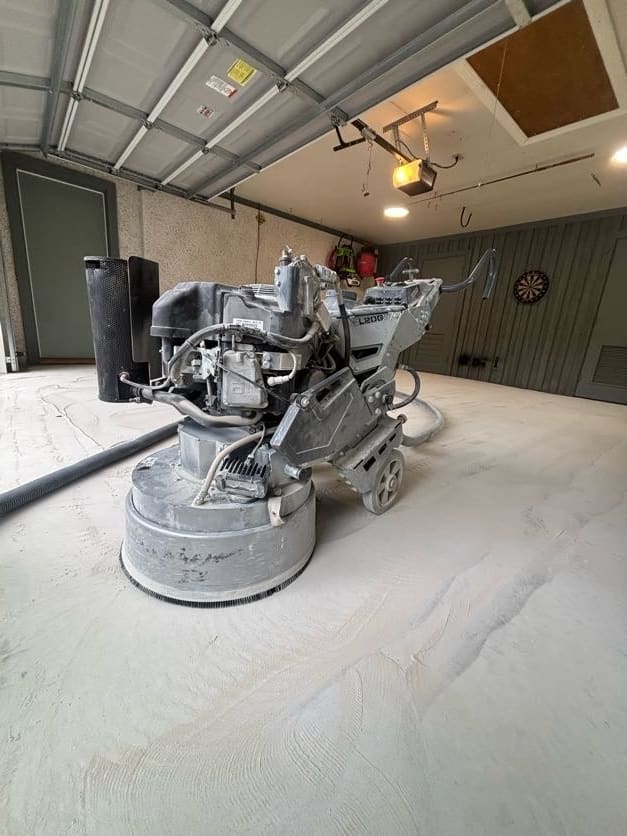
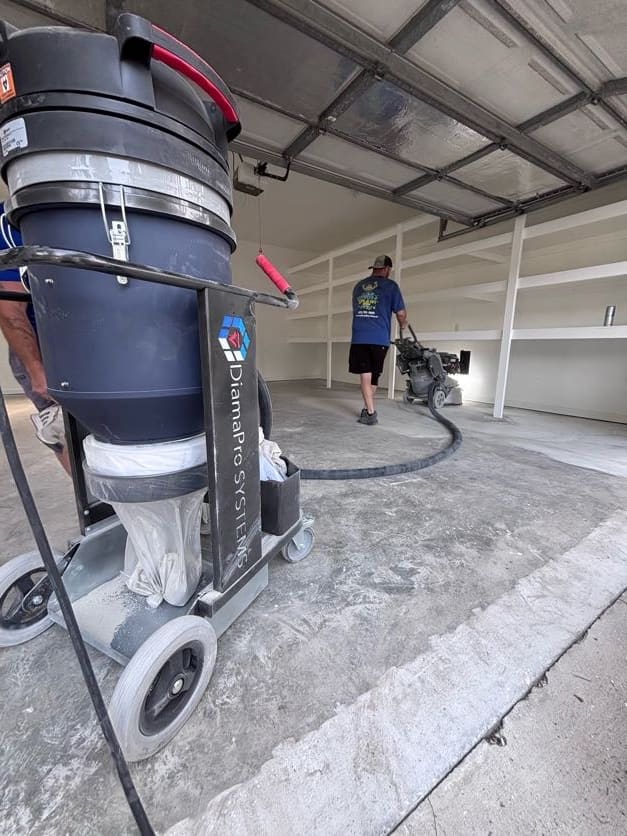
Overlays demand the most aggressive prep we do. The slab is ground to a CSP 3–5 profile with our 20–30 inch propane diamond grinders — coarser than coating prep, because the overlay needs real tooth to grip. We saw-cut keyways at every edge, doorway, and drain so the overlay locks in mechanically and can never curl or lift at a termination. HEPA vacuums keep even kitchen and food-plant sites clean throughout.
Our 20–30 inch propane planetary diamond grinders profile the entire slab evenly — no cords, no missed spots, no shortcuts. Every floor is mechanically ground to the correct concrete surface profile (CSP) for the system going down on top of it.
Our SVX-series industrial HEPA vacuums connect directly to the grinders, capturing dust at the source. Your home or business stays clean, and the slab is left spotless and ready to bond.
Coastal Georgia slabs carry moisture. We test every floor for moisture vapor transmission before a drop of product goes down — and apply a dedicated moisture vapor barrier when the readings call for it.
Cracks, spalls, and pitting get patched with fast-setting repair mortars and ground flush. Expansion joints are honored so slab movement never telegraphs through your new floor.
Urethane cement moves fast — most rooms are back in service within two to three days, and we plan the pour around your production schedule.
Slab condition, drains, cove heights, and your shutdown window mapped up front.
CSP 3–5 profile with keyed terminations at every edge and drain.
Urethane cement cove troweled up the walls for a seamless transition.
Self-leveling urethane cement raked at 1/8", quartz broadcast to rejection.
Polyaspartic lock coat, joint honoring, and final inspection.
"Frog Splash coated our entire auto shop — over 3,200 sq ft. They worked over a weekend so we lost zero business days. The floor has held up perfectly under daily vehicle and forklift traffic for over a year."
"We needed a USDA-compliant floor for our commercial kitchen. Frog Splash handled the spec, the coved base, and the whole installation without disrupting our lunch service. Health inspector approved on the first visit."
"Our warehouse had over 8,000 sq ft of damaged concrete. Frog Splash phased the work over two weekends — we never shut down. The floor is now completely transformed and we haven't had a maintenance issue since."
Frog Splash Coatings installs urethane cement and cementitious overlay systems for kitchens, breweries, and industry across Savannah, Pooler, Richmond Hill, Statesboro, Hinesville, and Brunswick, Georgia — plus Bluffton and Hilton Head, South Carolina.
Get Your No-Hassle Estimate Today